Weight and ballast
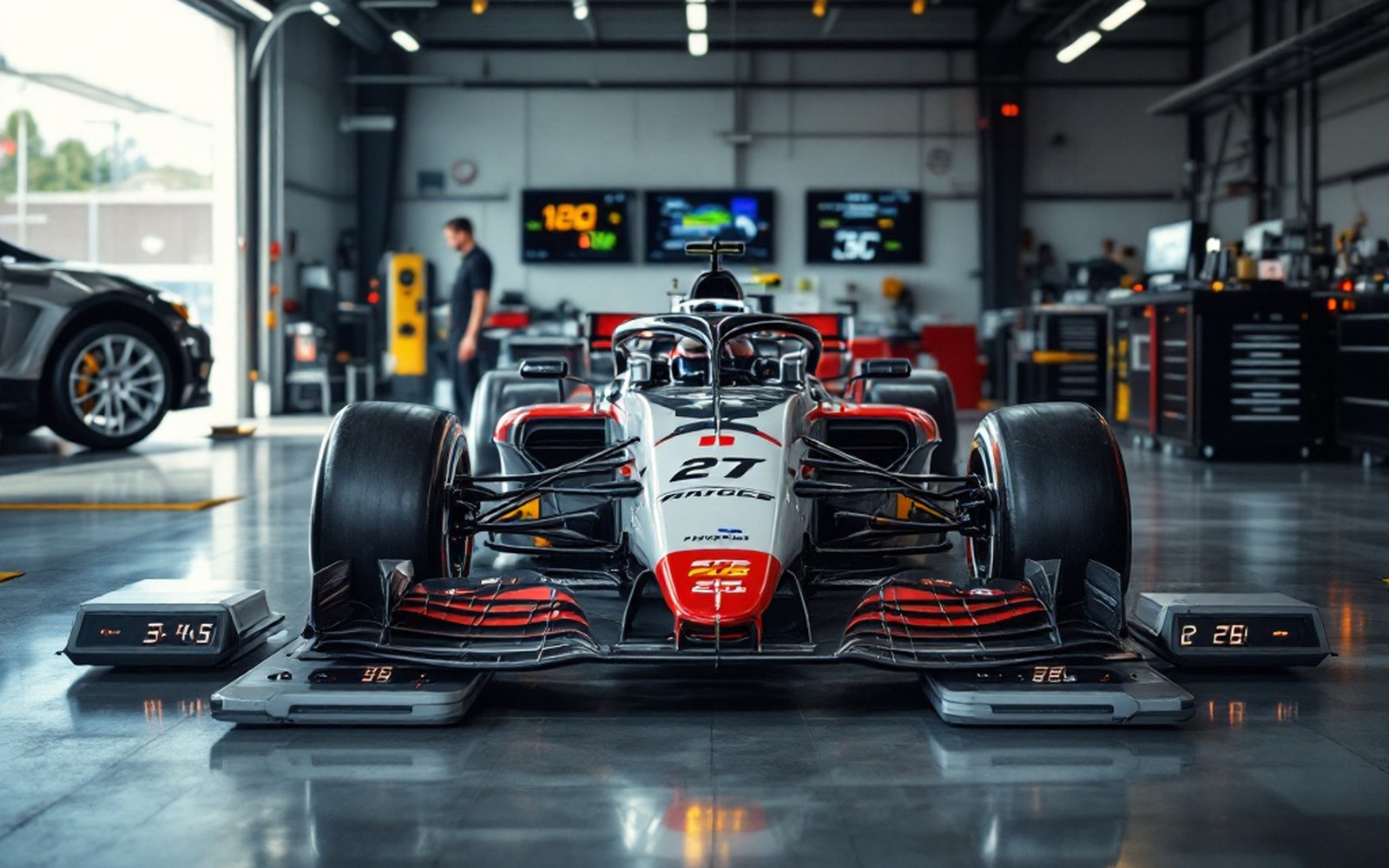
The scales at the end decide the race, which is why every kilogram is placed on purpose.
01The number in the rulebook
Every formula carries a minimum weight figure, and the figure is checked when the car returns to parc fermé — not when it leaves the garage. That distinction matters. A car may lose fluid, shed bodywork, or run its ballast out of specification during a race, and none of that is visible from the pit wall. The scales are what settle the question. An underweight car is excluded, regardless of where it crossed the line, and the margin for error is zero: the rule is a floor, not a target range.
In Formula One, the minimum weight figure has climbed steadily across the decades as safety structures, hybrid systems, and standardised components added mass. For most of the 1.5-litre turbo era, the limit sat at 540 kg including the driver, a figure that left the lightest constructors with surplus capacity they could fill deliberately. For 2023 the FIA set the combined car-and-driver minimum at 798 kg — a number that reflects survival cell requirements, battery mass, and mandatory ballast provisions for driver weight equalisation introduced in 2019.
Chronology
- 540 kgapproximate Formula One minimum, driver included, during the 1.5-litre turbo era of the early-to-mid 1980s
- 1984refuelling banned in F1; fuel-burn weight distribution becomes a primary design variable
- 2019F1 introduces minimum driver weight with personal ballast provision
- 798 kgFormula One car-plus-driver minimum for the 2023 season
02Ballast as a design tool
The ability to place ballast where the engineer chooses is worth more than the mass itself. A car built lean enough to run several kilograms below the limit can then load those kilograms into positions that optimise the weight distribution — low, central, and forward or rearward as the chassis demands. Gordon Murray's work at Brabham and later at McLaren was explicit about this: the goal was not merely to make the car light, but to make it light enough that the ballast placement became a tuning variable with the same standing as spring rates or aerodynamic settings.
In Formula One, the minimum weight figure has climbed steadily across the decades as safety structures, hybrid systems, and standardised components added mass.
The practical method is straightforward, though the precision required is not. Ballast is typically dense, machined metal — tungsten or lead alloys — bolted into recesses in the floor, the flanks of the monocoque, or beneath the fuel cell. Tungsten's density, roughly 19.3 g/cm³, means a small volume carries significant mass, which lets designers fit ballast into geometrically constrained locations without compromising ground clearance or structural integrity. Lead is cheaper and still common in categories where cost pressure is real.
Weight distribution is not a single number. It shifts as fuel burns, and a car that is correctly balanced at the start of a stint may be several percentage points different by the end. Teams model this fuel-burn curve and target a ballast position that keeps the car within an acceptable distribution window across the full stint rather than optimising one moment. In classes where refuelling was prohibited — Formula One from 1984 under the fuel allowances rules — this curve stretched long enough that the compromise became a primary design consideration.

03Scrutineering and the post-race check

Scrutineering for weight happens in two moments: once at the pre-event check, to confirm the car arrives within limits, and then decisively on the scales in parc fermé after the race. The post-race weighing is conducted with the car as it finished — no fluids added, no components replaced. Coolant lost to a leak, oil consumed, residual fuel: all of it counts. Teams must therefore build in a margin against the minimum to absorb that consumption without falling below the line. Too large a margin wastes the tuning benefit; too small a margin risks exclusion.
The FIA's Technical Regulations, published annually, specify the exact procedure: where on the car the load is applied, which components must be on board, whether the driver must be present or absent. Different formulas handle driver weight differently — some weigh car and driver together, others weigh them separately and add the figures. Since 2019, Formula One has required a minimum driver weight including ballast, so a lighter driver can install personal ballast in a designated seat position rather than leaving that mass at the car designer's disposal.
The scales are a simple instrument. The regulation attached to them is anything but: it encodes how much freedom a constructor has to use mass as a performance variable, and which competitive advantages are permitted to follow from that freedom.