Sliding skirts
The flexible plastic strip between the sidepod and the asphalt was the piece that made ground effect work — and regulating it out of existence took two attempts.

01What the skirt actually did
Ground effect depended on a sealed channel. Colin Chapman's Lotus 78 and 79 used the car's shaped underside as an inverted wing, generating low pressure beneath the floor — but only if the airflow stayed trapped. Without a physical seal at the outer edge of the sidepod, high-pressure air from outside bled underneath and destroyed the pressure differential. The sliding skirt was that seal: a strip of stiff but flexible material, typically a ceramic-faced plastic, spring-loaded to drag along the road surface and maintain contact over bumps. When it worked, it worked dramatically. Downforce levels climbed well past anything the wings on top of the car could generate, and lap times fell accordingly.
The skirts moved vertically relative to the car's sprung mass. As the car rode over a kerb or a bump the skirt slid up in its housing, then dropped back down under spring tension. That independence from the suspension was the point: the seal had to remain continuous regardless of what the road surface was doing. Teams spent enormous effort on skirt materials, guiding mechanisms and spring rates, because a gap of a few millimetres at speed could collapse the underbody pressure almost entirely.
02The rule that failed
The FIA first tried to regulate the skirts after the 1978 season, when the performance advantage they granted had become obvious to everyone. The 1981 technical regulations specified a minimum six-centimetre ground clearance, which should have prevented a seal reaching the road. Teams responded by building cars with rigid, fixed skirts set just at the limit in the garage, then running extraordinarily stiff suspension so the car sat at legal ride height in scrutineering and fell to a different attitude at racing speed. Scrutineering checked a static car. The rule, as written, had no mechanism to verify dynamic behaviour on the circuit, and gauges and templates applied at rest told nothing about what happened at 150 mph. The regulation was, in practical terms, unenforceable.
The skirts moved vertically relative to the car's sprung mass.
What the stiff suspension did to the drivers is a matter of the medical record — the cars transferred road irregularities almost directly to the cockpit, with suspension travel measured in single-figure millimetres. The aerodynamics demanded rigidity; the rigidity made the car brutal.
Chronology
- 1978Lotus 78/79 establishes ground-effect dominance; skirts widely adopted across the grid
- 1981FIA mandates 6 cm ride height; teams exploit static scrutineering with rigid suspension
- 1983Flat-floor rule introduced; makes skirts structurally redundant and enforceable by gauge
03The rule that held
For 1983, the FIA mandated a flat floor from the rear axle line forward to a prescribed point ahead of the front axle. A flat floor cannot form the convergent-divergent channel that ground effect requires. There was no loophole in the geometry: a flat surface is measurable on a static car with a straight-edge, and it remained flat at speed. The regulation was, at last, enforceable by a gauge rather than by trust. Sliding skirts became irrelevant once the tunnel they had been sealing no longer existed.
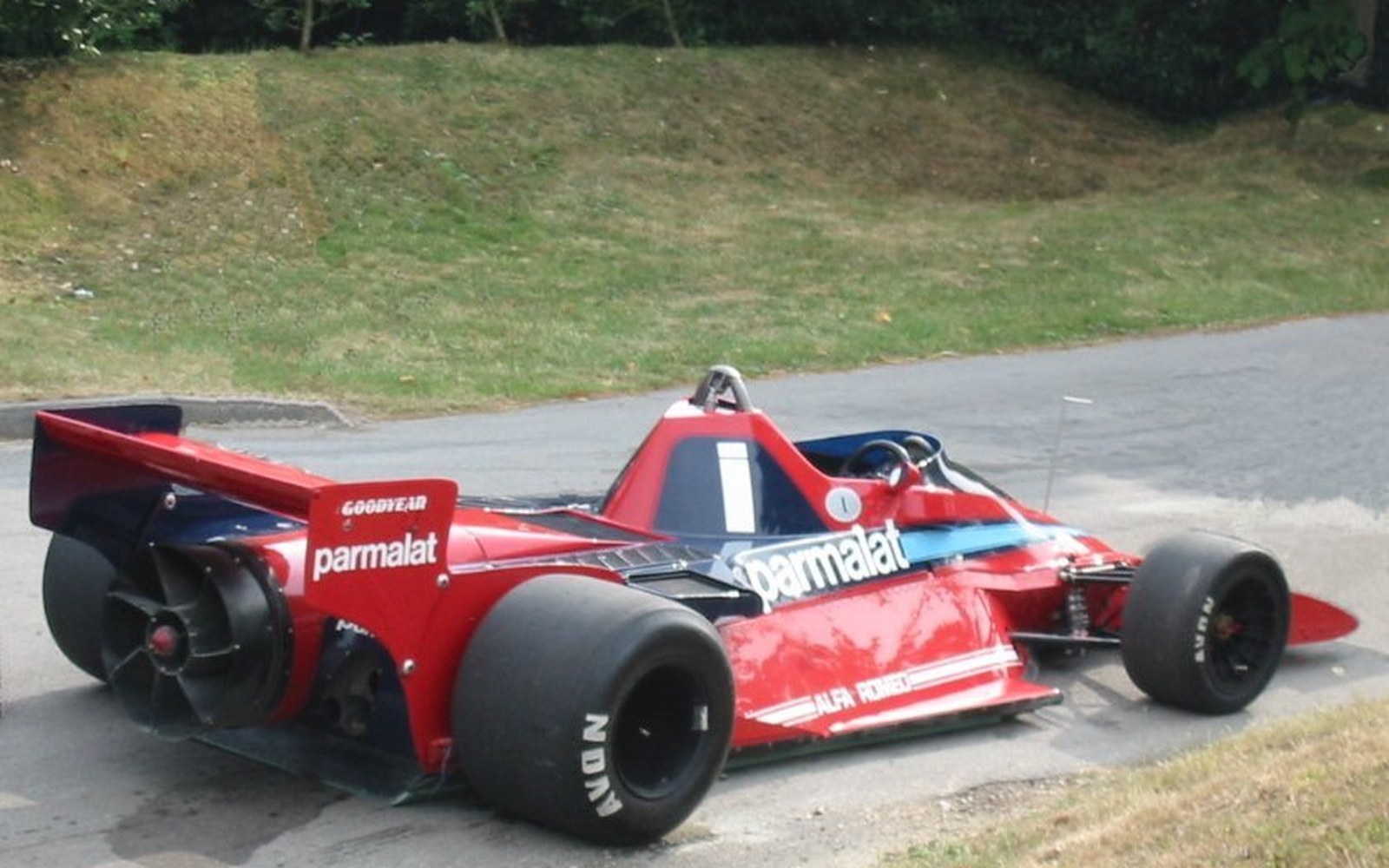
The Brabham BT46B had already demonstrated, briefly, that the principle could be implemented with a fan rather than a skirt — a different mechanical route to the same low-pressure result. That car ran once in competition in 1978 before being withdrawn. But the skirt-and-tunnel combination was the dominant form, and it was the skirt's ban that ended the era in stages — first badly, then for good.
The lesson the regulations drew was not that ground effect was inherently uncontrollable, but that a rule must be checkable at the moment of competition, not only in the controlled conditions of a scrutineering bay.