Ground effect
The underside of the car was a wing, the sidepods were the end plates, and nobody had written a rule against it.
01The tunnel underneath
When Colin Chapman's team ran the Lotus 78 in 1977, the paddock assumed the sidepods were a cooling arrangement. They were also an aerodynamic argument. Chapman and his chief aerodynamicist Peter Wright had recognised that the underside of a Formula One car — largely ignored since the category's open-wheel packaging made it awkward to work with — could be shaped as an inverted aerofoil. Pull enough air through a shaped tunnel and accelerate it, and the pressure differential between the floor and the atmosphere above would push the car onto the road with a force that front and rear wings alone could not approach.
The Lotus 78 was competitive. The Lotus 79, launched the following season, was transformative. Its sidepods were longer, more carefully sealed, and the underwing tunnels were more precisely profiled. Mario Andretti won the 1978 world championship in it, and for most of that year the opposition was not merely slower but structurally ignorant of why. The car's lap times in clean air were of a different character from anything that conventional downforce had produced.
The physics were not new. The ground effectprinciple — that a wing in close proximity to a surface generates disproportionate downforce because the ground interrupts the pressure-recovery path — had been demonstrated in engineering literature well before Chapman applied it. What was new was the ambition: an entire car designed around that phenomenon, with the bodywork shaped to channel and contain the low-pressure region as efficiently as possible.
02What the rules said
The Appendix J regulations of 1977 were not silent on aerodynamics, but they were silent on the floor. Rules existed to constrain movable devices, wings beyond specified dimensions, and bodywork ahead of the front axle line. They said nothing about shaping the underside of the monocoque or its sidepod extensions. The fiche — the homologation form that fixed the geometry of each car — did not yet have a field to capture underbody profile. That omission was the opening.
Chronology
- 1977Lotus 78 introduced; sidepod tunnels and skirts first deployed competitively
- 1978Lotus 79 dominates; Mario Andretti wins championship; ground effect widely understood and copied
- 1980–81FISA attempts skirt ban; contested compliance; rigid low-clearance skirts used as workaround
- 1982Colin Chapman dies, December
- 1983Mandatory flat floor from front to rear axle line; underwing tunnels effectively outlawed
- 2022FIA technical regulations permit full venturi tunnels again, under tightly specified parameters
What amplified the effect dramatically was the sliding skirt: a flexible or spring-loaded strip that ran along the outer edge of each sidepod and sealed the gap between the floor and the road surface. Without it, air leaked under the edges and equalised the pressure difference. With it, the low-pressure tunnel was contained. The skirt was the device that turned an aerodynamic theory into a cornering-speed revolution. By 1979 and into 1980, every serious constructor was building their own interpretation of the same idea, and sliding skirts had become the central engineering preoccupation of the grid.
Cornering loads climbed to levels that drivers described as qualitatively different from what had preceded them. Tyre engineers had not anticipated the sustained lateral forces. Circuit barriers had not been designed for the kinetic energy of a car travelling through a corner as if on rails. When a skirt failed or a tyre went, the car simply lost its downforce and spun without warning — there was no graduated handling signal, no progressive onset of understeer. The failure mode was binary.
The Lotus 79, launched the following season, was transformative.
03FISA rewrites the floor
The governing body FISA acted in stages. A flat underbody requirement was being discussed as early as 1980, when the organisation also attempted to ban sliding skirts outright; the immediate ban was suspended under protest from constructors and eventually implemented for 1981, though compliance was contested through much of that season. Teams produced cars with rigid skirts running very close to the road, effectively approximating the seal by other means. The argument about what constituted a sliding skirt, and what was merely a closely fitted static surface, ran through scrutineering queues at several events.
The definitive regulatory answer arrived for 1983: a mandatory flat floor from the front axle line to the rear axle line, checked by a template at scrutineering. The floor could not be profiled as a diffuser in the critical central section; the underwing tunnel as Chapman had designed it became geometrically impossible. Constructors retained diffusers behind the rear axle — a partial ground effect that remains regulated and exploited today — but the sealed-tunnel approach that had defined four seasons of Formula One was written out of the rules by a dimension and a flat-surface requirement.
The 1983 regulation did not cite safety directly, but the context was not ambiguous. Cornering speeds at circuits such as Dijon-Prenois and Silverstone had risen sharply through the ground-effect era. The failure behaviour of skirt-equipped cars had produced accidents; the loss of downforce at speed was not survivable in the way that mechanical failures at lower cornering loads might be. The rule was a speed reduction enforced through geometry.
04What was inherited
Chapman did not see that regulatory response; he died in December 1982, before the flat-floor rule came into force. What he left behind was not just a design but a demonstration: that the largest aerodynamic resource on a racing car was the one nobody had bothered to specify. Every subsequent floor regulation — the flat-floor rule of 1983, the stepped floor introduced in the mid-1990s and revised thereafter, the return to full ground-effect tunnels permitted by the 2022 technical regulations — is written in direct response to what the Lotus 78 and 79 proved was possible.
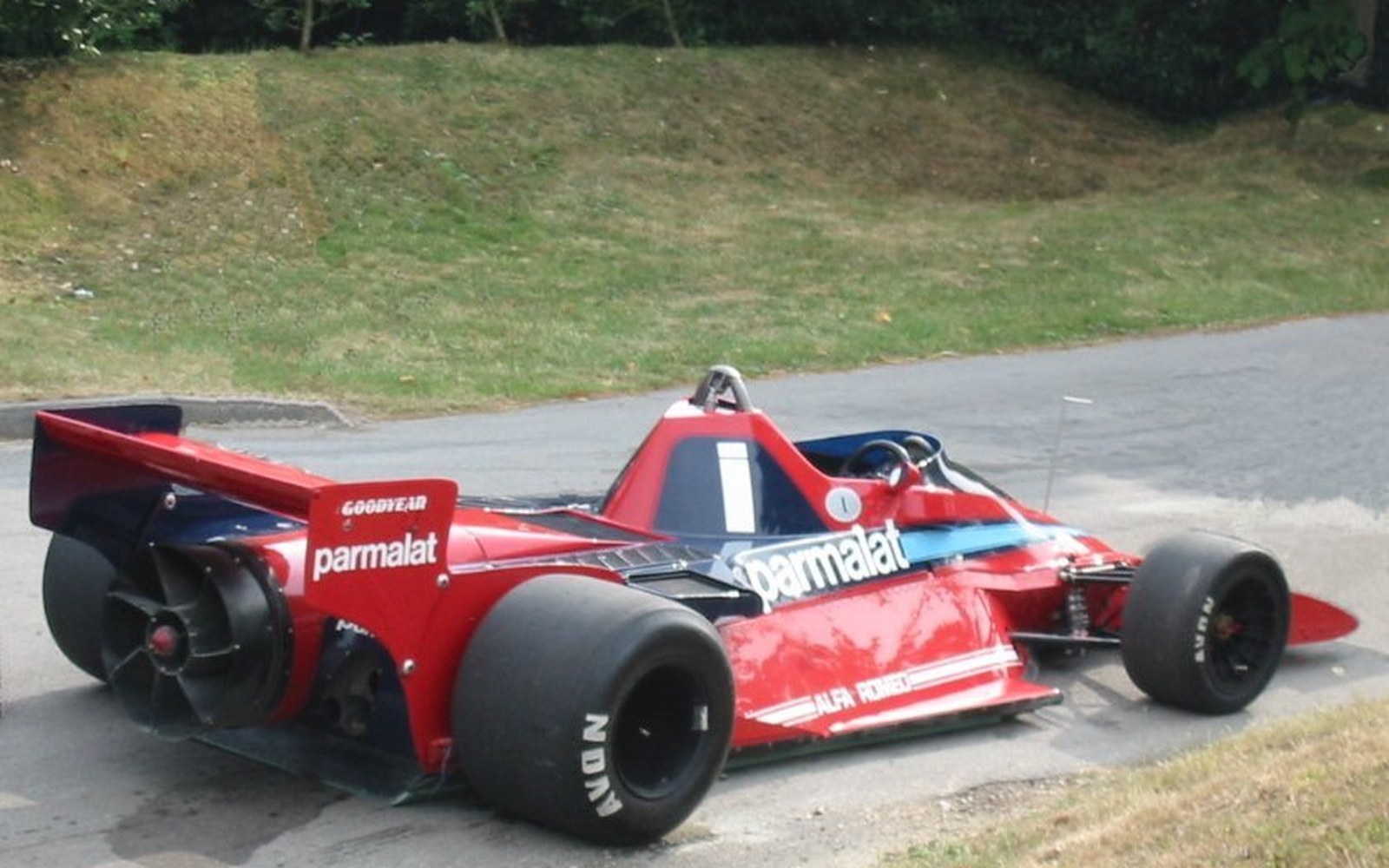
Gordon Murray at Brabham had understood the same physics by 1978 and was developing his own ground-effect car before switching direction entirely, producing the fan-assisted BT46B as a lateral solution to the same problem. The principle had spread fast precisely because it worked so well: it required no additional mechanical components, just geometry and a seal. What the rules had not defined, engineers had defined for themselves.
The lesson scrutineers drew was durable. A regulation that specifies only what is prohibited — rather than what the floor must be — leaves every unprescribed surface available for exploitation. The flat floor closed the tunnel. It did not end the argument about the underbody; it moved that argument to the diffuser, the plank and the beam wing, where it continues.
Named in this entry
Colin Chapman
Team Lotus
His Lotus 78 and 79 used the underside of the car as a wing, in a rulebook that had not thought to describe the floor at all.
Gordon Murray
Brabham
Designed the BT46B, cooled by a fan that also extracted air from beneath the car. It won at Anderstorp in 1978 and was withdrawn afterwards.