Boost limits
A pop-off valve did what a power limit never could: it set the ceiling with a piece of hardware, not an honour system.
01The problem a power limit cannot solve
Through the middle of the 1980s, Formula One's 1.5-litre turbos were producing outputs that the sport's own technical staff could barely measure, let alone govern. BMW Motorsport's four-cylinder, developed by Paul Rosche's engine group, was quoted at figures well above 1,000 bhp in qualifying trim. Renault Sport and Honda were not far behind. The numbers were estimates — dyno readings at sea level, engine internals that would last perhaps a single flying lap before needing replacement. A power limit written in horsepower would have required the FIA to verify power at the circuit, with no reliable method to do it. Teams would simply have disputed every figure.
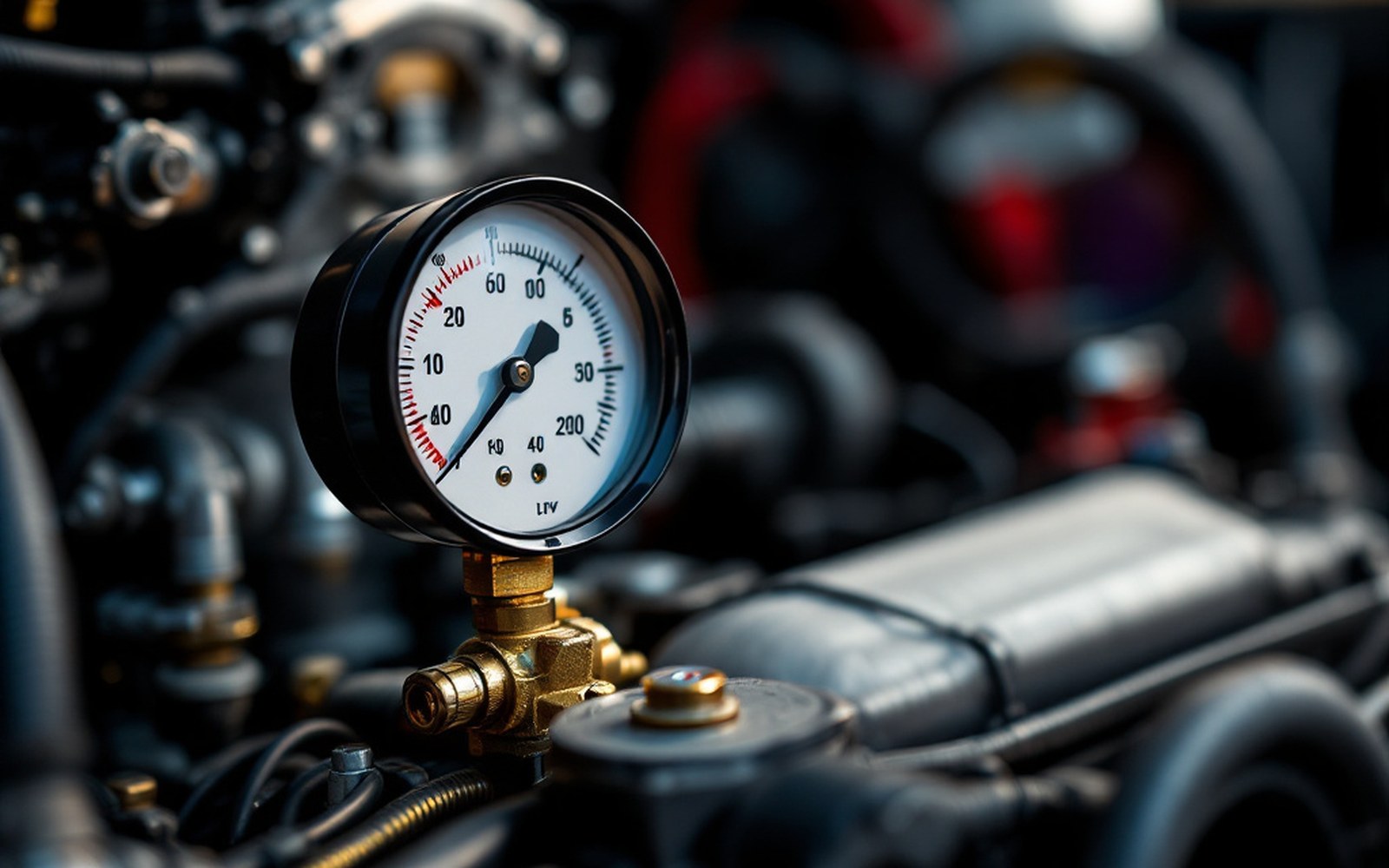
Boost pressure is different. It is a single number, measured by a mechanical device, auditable at the car. FISA — the sporting arm of the FIA that governed Formula One at the time — recognised this by the mid-1980s. Rather than legislating the output of the engine, it would legislate the pressure of the air going into it. The instrument chosen was the pop-off valve, a pneumatic relief valve set to open at a fixed threshold and vent excess pressure to atmosphere. Once it opens, the engine cannot make more boost than the valve permits, regardless of what the turbocharger or the engine management is doing. The power limit became a physical fact rather than a written promise.
02Four bar, then two and a half
The regulations introduced the pop-off valve for the 1987 season with a limit of 4 bar absolute — meaning four times atmospheric pressure at the inlet. That figure still permitted enormous power outputs; the engines of 1987 were making somewhere in the region of 900 bhp in race trim, with qualifying modes higher still. The valve's role that year was less about reducing performance immediately and more about establishing the mechanism: fitting teams and engine builders to a hardware-enforced ceiling so that the ceiling itself could be tightened.
It is a single number, measured by a mechanical device, auditable at the car.
For 1988 FISA moved the valve to 2.5 bar absolute. The effect on fuel consumption and race strategy compounded the restriction, because the fuel allowance had already been cut in preceding seasons, but the boost limit was the primary instrument. At 2.5 bar, the Honda V6 running in the McLaren MP4/4 was producing race outputs estimated at around 650 bhp — formidable, but a fraction of what the same engine architecture had delivered eighteen months earlier. The naturally aspirated alternative, permitted that season at 3.5 litres, remained uncompetitive on outright power but was now at least in the same conversation.
Chronology
- Mid-1980squalifying outputs quoted as estimates; no viable method to police a power limit
- 1987pop-off valve introduced at 4 bar absolute; mechanism established
- 1988valve tightened to 2.5 bar; turbocharged engines still dominant over the 3.5-litre atmospherics
- End of 1988turbo engines banned; pop-off era ends
The valve itself was supplied and sealed by the governing body. Teams could not recalibrate it, because the valve was not theirs to calibrate — it was fitted at scrutineering and its seal checked before and after the race. Scrutineering had always been about measuring the car against a written specification; the pop-off valve made the boost limit a physical part of that process. A broken or missing seal meant exclusion. The device turned a pressure figure in the regulations into something a scrutineer could verify in two minutes with a visual inspection.
What the rule also did, quietly, was determine the entire engine development direction for 1988. With the pressure ceiling fixed, engineers could no longer chase power by increasing boost when reliability was needed. The gains available were in thermal efficiency, fuel chemistry and mechanical friction — marginal improvements at the edges, not step changes. Fuel allowances made this still more acute: at 2.5 bar, managing consumption over a race distance without a performance deficit required a different kind of engineering from the arms race that had characterised the previous four seasons.
Turbocharged engines were banned from Formula One at the end of 1988, making the 2.5-bar season their last. The pop-off valve's logic, however, survived it: the principle that a physical device in a sealed enclosure enforces a performance ceiling better than any written clause is now embedded in how boost and rev limits are structured across multiple FIA categories. The honour system never came back.