Pushrod boost at Indianapolis
The rules gave pushrod engines extra boost to help them survive. Illmor read the exact same words and built an engine designed around nothing else.
01The concession and the clause
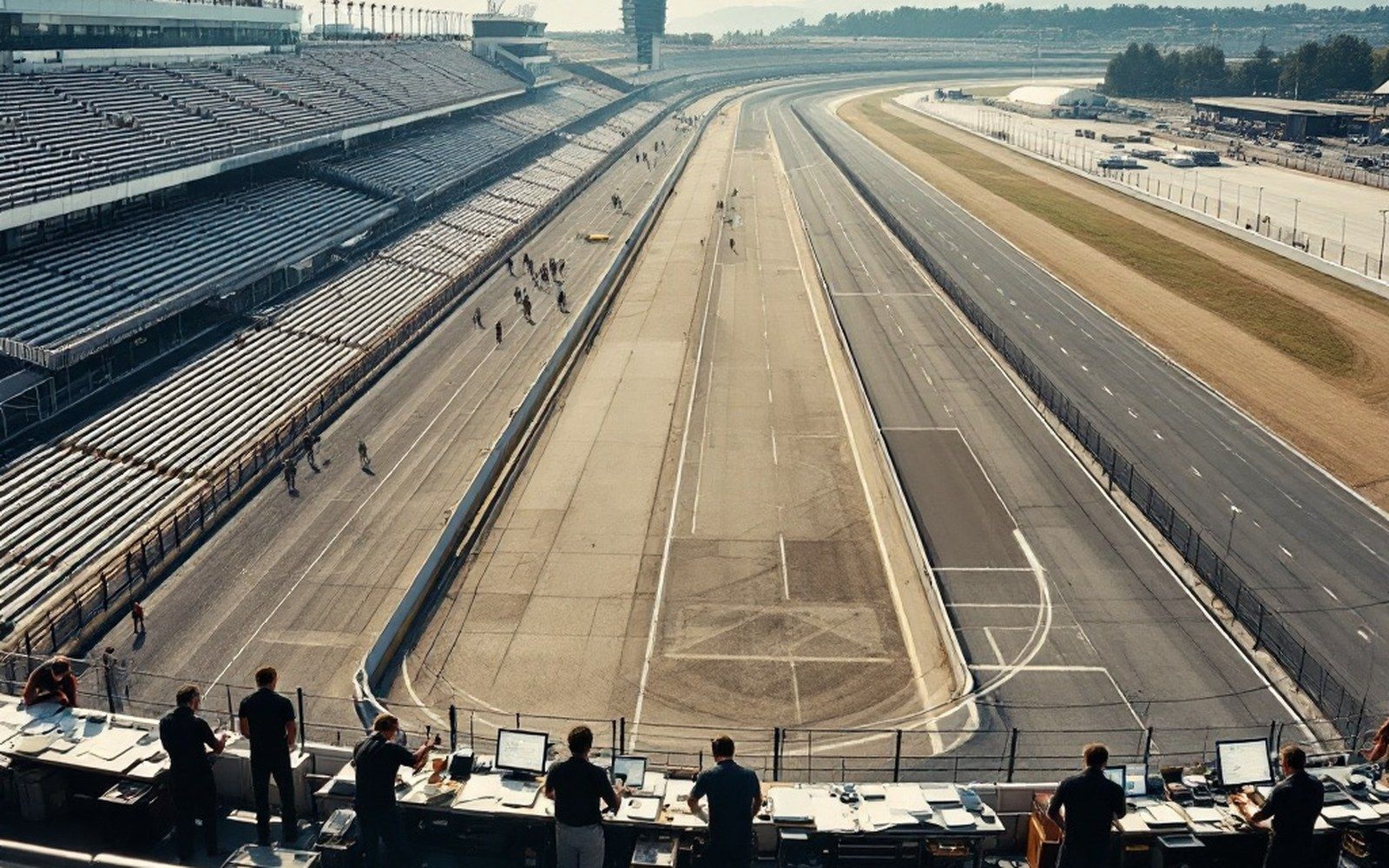
The Indianapolis Motor Speedway, Speedway, Indiana, hosts a race that has always been governed by its own technical formula, separate from Formula One and separate from what the FIA sanctions on the rest of the calendar. By the early 1990s, the IndyCar series ran under USAC and then CART regulations that permitted turbocharged engines with a displacement limit and a boost cap — but the drafters of those rules had built in a carve-out meant to protect the old American pushrod V8, the kind of engine that had defined the race for decades before the overseas overhead-cam turbos arrived. The concession was simple and explicitly numerical: pushrod engines were permitted to run higher boost than overhead-cam engines. The logic was equalisation — pushrod architecture was understood to be inherently less efficient, less able to breathe, less amenable to the cylinder-head geometry that made a turbo sing. The clause was written to keep them in the game, not to invite a new game entirely.
The relevant regulation allowed pushrod engines to run with a boost limit meaningfully higher than the 45 inches of mercury cap applied to the overhead-cam competition. The precise figure for pushrods was 55 inches of mercury — roughly 1.9 bar absolute — at a time when overhead-cam engines were already extracting enormous power from their permitted ceiling. The gap looked like a handicap correction. It was, instead, a target.
Chronology
- 1993–94Illmor and Penske develop the X/B in secret
- May 1994Penske PC23s qualify 1st, 2nd and 3rd at Indianapolis; Al Unser Jr wins
- 1995USAC revises the pushrod concession; Penske-Mercedes project discontinued
02Illmor's literal reading
Ilmor Engineering, the Brixworth firm co-founded by Mario Illien and Paul Morgan, was already well established as an engine builder of the first order — their work underpinned Mercedes-Benz's involvement in American open-wheel racing. In 1993 and into 1994, Illmor, with backing from Roger Penske's organisation and the resources of Mercedes-Benz, set about building an engine that was not designed to be competitive despite the pushrod layout but because of it. The architecture was chosen for the clause it unlocked. Every engineering decision downstream of that choice was then optimised around the higher boost figure the regulations permitted.
Every engineering decision downstream of that choice was then optimised around the higher boost figure the regulations permitted.
The result was the Ilmor X/B, a compact 90-degree V8 with pushrod-actuated valves — genuinely pushrod in the letter of the regulation — but with nothing else about it that resembled the venerable American stockblock it was supposedly kin to. The engine was purpose-engineered, with a very short stroke, a deliberately small displacement well below the maximum allowed for pushrod entries, and an architecture chosen to survive and exploit extreme turbocharger pressure rather than to generate power through displacement or valve area. The pushrods were there. The spirit of the concession was not the concern of the people who built it.
The engine was installed in a Penske PC23 chassis, and the combination arrived at Indianapolis in May 1994. Three cars ran it: Emerson Fittipaldi, Paul Tracy and Al Unser Jr. They qualified first, second and third. Unser won the race by a margin that made the advantage unmistakable. The Penske-Mercedes cars led every lap between them that mattered, and the engine's power output — quoted at the time in the region of 1,000 horsepower — reflected what the extra boost increment was worth when an entire engine had been designed around extracting it rather than tolerating it.
03What the rule said and what it meant

The distinction that the Illmor project exposed is the one that sits at the heart of every loophole dispute: the difference between the purpose a rule was written to serve and the literal content of the words on the page. The drafters of the pushrod concession had imagined a modest, production-based stock-block pushrod engine — an engine from a different engineering tradition that needed a handicap correction to remain viable. They had not imagined an engine designed from a blank sheet, by one of the most capable engineering teams in the world, with the sole purpose of being a pushrod engine that ran at 55 inches of mercury.
Nothing about the Illmor X/B was illegal. USAC scrutineering found no violation. The valves were operated by pushrods, the displacement was within the permitted envelope for pushrod entries, and the boost was kept within the limit the rules assigned to that category. The car passed every check it was presented with, because it had been built to pass them. This is the mechanism by which a concession written for one technological world is captured by another: the regulation specified a measurable physical attribute, not an intent. As long as the attribute was present, the concession applied.
04The aftermath and the rewrite
The rules were changed for 1995. USAC closed the specific avenue the Illmor engine had used — adjusting the regulations so that the architecture concession could no longer be exploited by a purpose-built engine designed entirely around the boost differential — and the Penske-Mercedes project was discontinued. The engine ran competitively at exactly one Indianapolis 500 and never started another. Its record at that race — pole position and victory — is permanent; the regulation that made it possible is not.
What the episode clarified, for anyone who needed clarification, is that an equivalence formula is only as robust as its least examined assumption. The pushrod concession assumed that pushrod engines were intrinsically limited in ways that made the extra boost merely compensatory. Illmor's engineers tested that assumption and found it was not a physical law but a historical observation about the engines that had previously existed. A new engine, built after the rule was written, was not bound by the same history. The clause said pushrod; it did not say old, or limited, or slow. Those were implications that never made it into the text, and regulations that rest on implication rather than measurement are the ones that tend to be rewritten the season after someone reads them carefully enough.
The Illmor X/B spent one month as the fastest thing at Indianapolis and the rest of its existence as the clearest demonstration in American open-wheel racing of what happens when a concession is written for a category of engine rather than for the engines that actually exist within it.