Six wheels
When the regulations specified a maximum wheel diameter but forgot to count the wheels, one constructor found a gap worth exploiting.
01The sentence that wasn't there
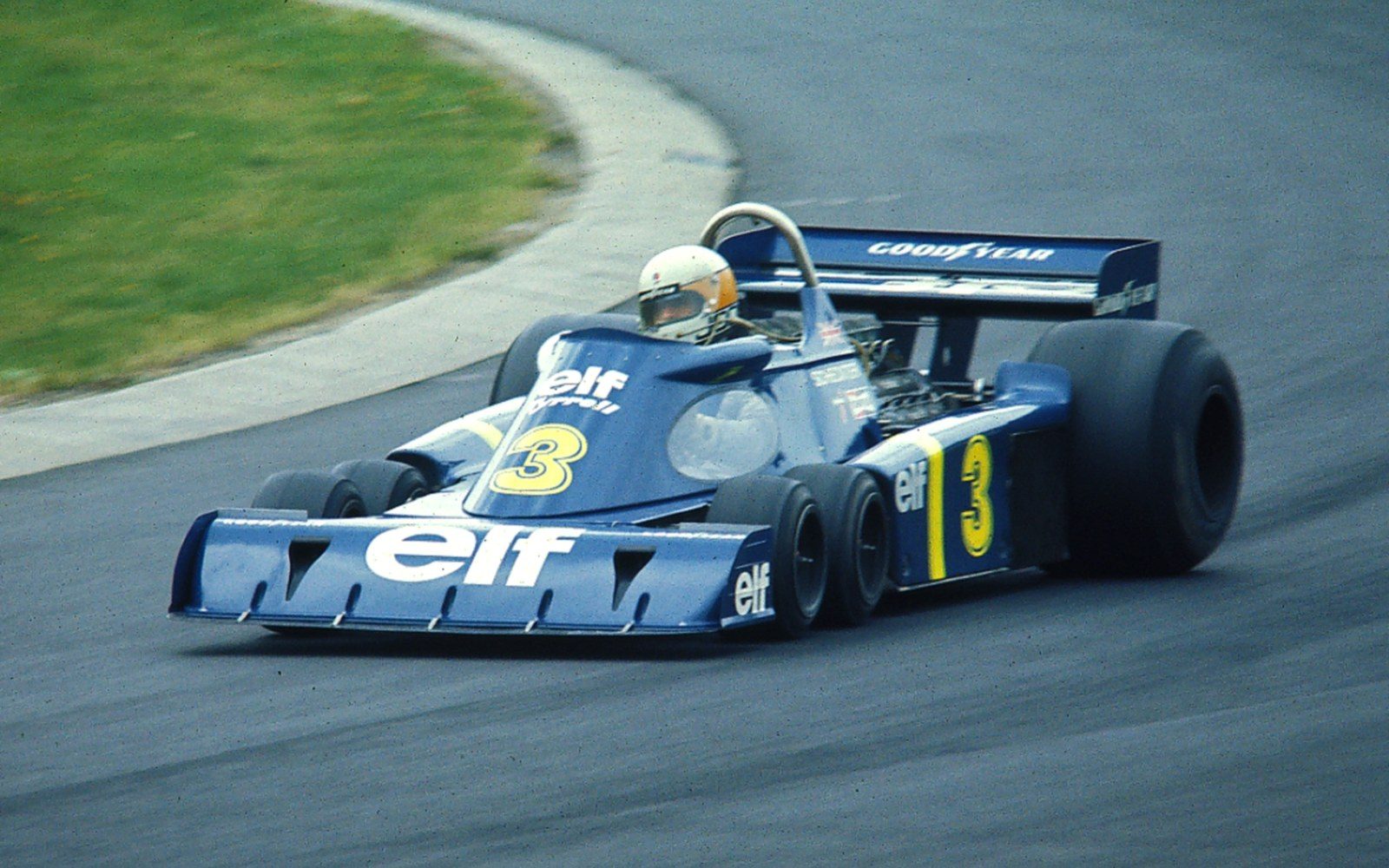
Formula One's technical regulations in 1976 said a good deal about wheels: their diameter, the width of the rim, the type of tyre. What they did not say was how many a car could have. That omission — a silence rather than a permission — was enough for Tyrrell to build the P34, a six-wheeled Grand Prix car that was entirely legal and won a race.
The thinking belonged to Derek Gardner, Tyrrell's chief designer. The front end of a Formula One car was, in his analysis, a problem of aerodynamic drag: two large front tyres sitting upright in the airstream, presenting a substantial frontal area that the regulations did nothing to minimise. His solution was to replace each front tyre with two narrower, smaller-diameter wheels, running side by side on a common stub axle. Four wheels at the front, two at the rear. The frontal area dropped, and the contact patch — spread across four tyres — stayed workable. Nothing in Appendix J said otherwise.
Chronology
- 1976Tyrrell P34 debuts mid-season; Scheckter/Depailler win the Swedish Grand Prix at Anderstorp
- 1977P34 runs full season; tyre development stalls; project wound down
- 1977/1978FIA amends regulations to restrict the number of wheels
- 1983Explicit "four wheels" rule fully codified
Tyrrell ran the P34 through the entire 1977 season, having debuted it in 1976, and Jody Scheckter and Patrick Depailler drove it to a one-two finish at the 1976 Swedish Grand Prix at Anderstorp — the only time in history that result was achieved by a six-wheeled car. The concept had real merit: the smaller front tyres generated less aerodynamic drag, and the four-contact-patch layout gave excellent feel at the front under braking. The problem, which deepened through 1977, was tyre supply. Goodyear had agreed to develop a dedicated small-diameter front tyre for the project, and the compound development never kept pace with what the car needed. A wider supplier base might have extended the experiment; with one compound from one supplier, the development ceiling arrived early.
The thinking belonged to Derek Gardner, Tyrrell's chief designer.
02What the rules said next
The FIA's response to the P34 was not immediate exclusion — the car was legal — but it was definitive. The regulations were amended after the 1977 season, and from 1983 onward the wording was explicit: a Formula One car must have four wheels. Four, not "a minimum of four". The silence was filled with a number, and it stayed filled.
That amendment is itself a regulatory case study. Rules in motorsport are habitually rewritten not to close a gap in principle but to close the specific gap just used, and the six-wheel rule followed that pattern precisely. The underlying logic — that anything not forbidden is permitted — remained intact everywhere else in the regulations. What changed was that this particular dimension of freedom was removed, because someone had found it and built something with it.
Tyrrell was not alone in exploring the concept. Williams drew up a six-wheeled layout for a proposed car — the FW07D — that reversed the formula: four wheels at the rear, two at the front, with the intention of maximising driven contact patch on the exit of corners. Gordon Murray at Brabham sketched parallel exercises. None of those rear-engined, four-rear-wheel configurations ever raced before the regulations closed, because the amendment came swiftly enough to forestall them. The Williams project is documented in the team's own archive, and the logic it followed — more driven rubber, more traction — was the mirror image of Gardner's aerodynamic argument.
The Tyrrell P34 therefore occupies a precise position in regulatory history: the only six-wheeled car to score points, to win a race, and to survive scrutineering through an entire season of Formula One — not by bending a rule but by reading the space between rules accurately. Gardner found a sentence that wasn't there, raced it for two seasons, and watched the FIA write the sentence afterwards. The car looked the way it did because the regulations, in that moment, allowed it to.