Fuel cells
The rubber bladder, the foam fill, and the stamped expiry date that together make a fuel tank a safety device rather than just a container.
01What the rule replaced
Until the 1960s, a racing car's fuel tank was exactly what the word implied: a shaped metal container, usually aluminium, installed wherever the designer had space. It held fuel. When it ruptured in a crash, it spilled fuel. When fuel spilled near hot bodywork or an electrical arc, the result was a fire that no amount of marshalling could reliably control. The FIA began writing structural requirements for fuel containment into its regulations as the accident record made the consequences undeniable.
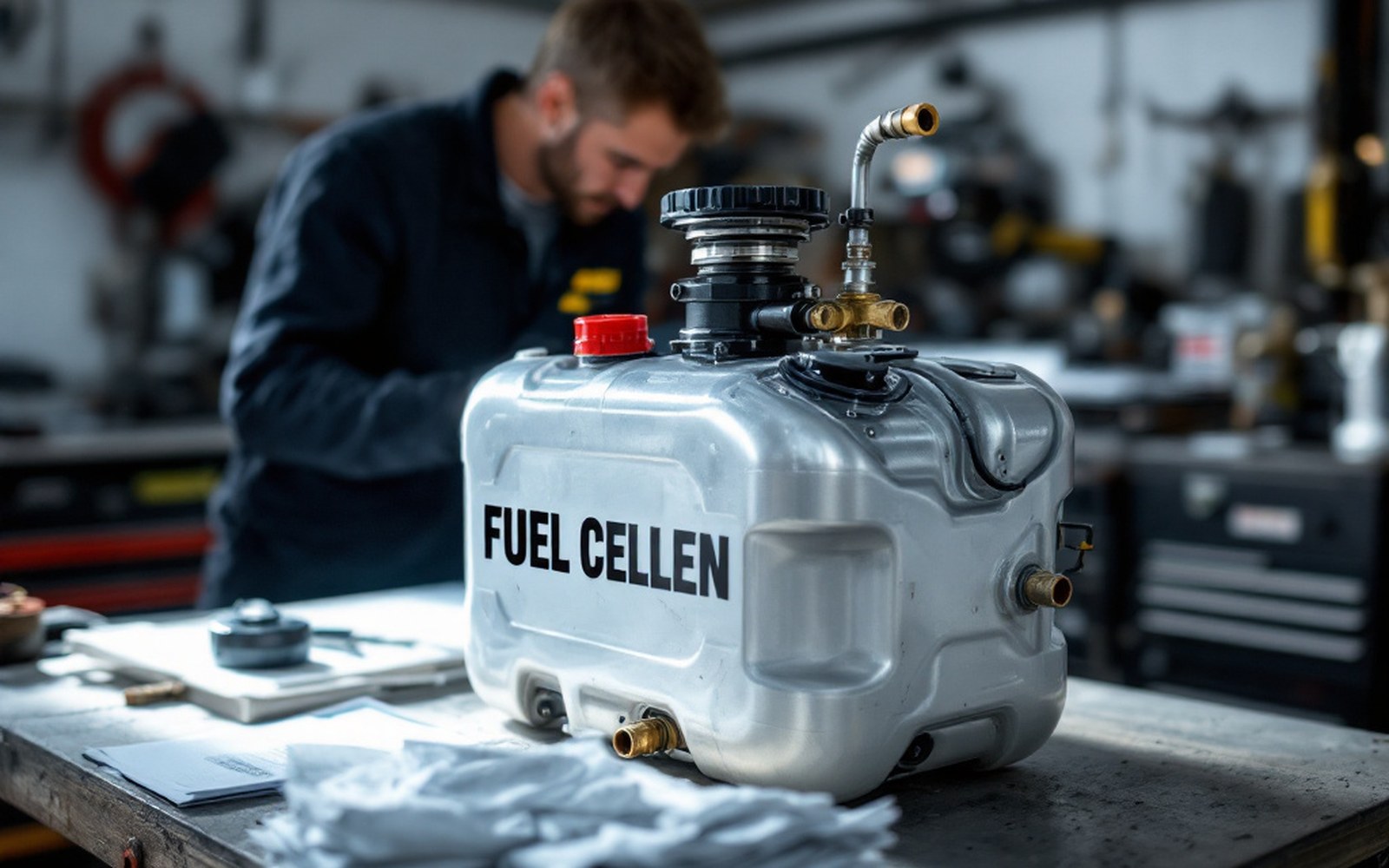
The solution had already been developed outside motorsport. Military aviation had been using self-sealing, puncture-resistant flexible fuel bladders since the Second World War, and the underlying technology transferred to racing with some modification. A fuel cell is not a tank in any traditional sense. It is a multi-layer rubber bladder — the inner surfaces chemically resistant to fuel, the outer layers tough enough to resist tearing — fitted inside a rigid outer container and packed internally with open-cell polyurethane foam. The foam does not absorb significant fuel; it breaks up the liquid mass so that in a violent impact the contents cannot slosh and surge in a way that ruptures the bladder from within, and it suppresses the vapour space above the liquid that would otherwise create an explosive headspace.
02The specification, the stamp and the service life
What makes the fuel cell a regulatory object rather than just a good idea is that its construction is defined to a written standard. In international circuit racing, the relevant benchmark is the FIA's own specification, which sets minimum material thicknesses, burst pressures, and the conditions under which a bladder must survive a defined impact without leaking. Equivalent requirements exist in American racing through the SFI Foundation's standards, which are published and versioned by category, so that scrutineers can verify compliance against a numbered document rather than a subjective assessment.
What makes the fuel cell a regulatory object rather than just a good idea is that its construction is defined to a written standard.
The stamped date is the practical consequence of this. Rubber ages. The chemical resistance of the inner lining and the tear resistance of the outer layers both degrade over time, and a bladder that passed its original test may not pass it five years later. Regulations therefore fix a service life — typically around five years from the date of manufacture, though the precise figure varies by series and standard. The date is moulded or stamped into the bladder itself, and scrutineering can check it without any special equipment. A cell past its date is illegal regardless of its visible condition, because the degradation that matters is not always visible. This is not an arbitrary choice: it is the same logic that governs the service life of a firesuit or a helmet shell, where the material's structural properties are the point and appearance is unreliable evidence of them.
Chronology
- Second World Warmilitary aviation develops self-sealing flexible bladder tanks; technology base for later motorsport adoption
- 1960sFIA begins writing structural fuel containment requirements into international racing regulations
- 1983flat-floor regulations in Formula One force new fuel cell packaging geometries
- 1986Group B accidents sharpen FIA requirements for fuel system integrity in rally cars
- Post-1986tightened fuel containment rules across categories draw on lessons from that season
The foam fill carries its own specification. It must be fuel-resistant, it must not compress permanently under the fuel load (which would reduce its vapour-suppression function over time), and it must fill the interior volume to a minimum density. A bladder without the correct foam is not a fuel cell by the regulatory definition, even if it looks like one.

03From rally to formula

Group B rallying brought fuel cell requirements into sharp focus. The cars ran in remote terrain, far from fire crews, and a post-accident fire in those conditions was a different problem than one on a circuit. Lancia Delta S4 development at Abarth in Turin gave serious attention to fuel containment precisely because the mid-engined layout placed the tank in a location exposed to rear impact energy. The FIA's tightening of fuel system requirements after the 1986 season drew directly on what those accidents demonstrated.
In Formula One, the flat-floor regulations of 1983 and the progressive reduction in car dimensions through the 1.5-litre turbo era forced fuel cell packaging into increasingly constrained spaces, which in turn drove development of bladder materials that could conform to complex shapes without creasing — a crease being a stress concentration that shortens service life. The rule that said where the fuel had to sit also shaped what the fuel container had to be made of.
The stamped date is easy to miss on a car that has been prepared with obvious expense and care. Scrutineers do not miss it.