Lancia Delta S4
Two compressors, one manifold, and a rulebook that said nothing about combining them
01What Abarth found in Appendix J
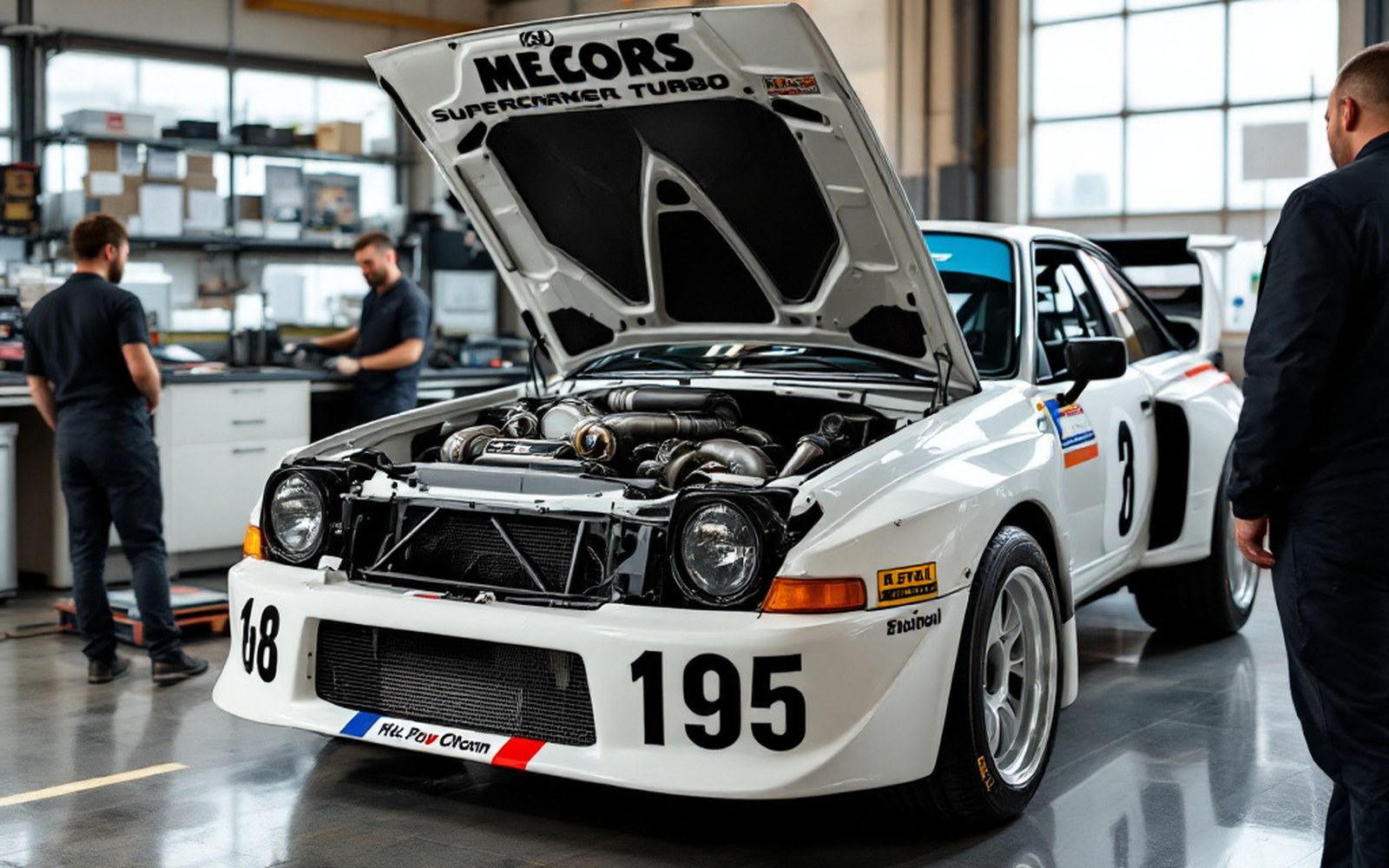
Group B set a floor — two hundred homologated road cars — and then stepped back. The FIA's Appendix J said nothing that prohibited supercharging. It said nothing that prohibited turbocharging. It was entirely silent on the question of running both simultaneously. Sergio Limone, leading the powertrain programme at Abarth in Turin, read that silence as permission, and the result was the Delta S4's twin-charging system: a Volumex roots-type supercharger handling throttle response from idle while an exhaust-driven turbocharger built pressure at higher engine speeds. The two units shared a single intake manifold. The car's name was borrowed from a front-wheel-drive hatchback it shared almost nothing with.
The chassis was a fabricated steel spaceframe — not a monocoque — clothed in composite bodywork. Drive went to all four wheels through a Ferguson-type viscous coupling centre differential, the layout allowing torque distribution to be tuned before a stage rather than demanded from electronics that barely existed in a competitive form. The four-cylinder engine displaced around 1,759 cc and in competition trim produced figures that the team preferred to quote cautiously; contemporary estimates ran well above 400 bhp in race configuration, with more available for qualifying. The body was kept deliberately narrow relative to its competitors: Limone's team prioritised weight distribution and packaging over maximum aerodynamic platform width.
Chronology
- October 1985S4 receives FIA Group B homologation
- November 1985RAC Rally debut; Toivonen wins
- 1986 seasonAlén and Toivonen campaign the car in WRC
- May 1986Tour de Corse; end of S4's competition life
- End of 1986Group B abolished by FIA
Homologation was granted in October 1985. The homologation form — the fiche, the document that legally defined what the car was — fixed the specification against which scrutineers would check every component at every event. Lancia had built the required two hundred examples to qualify, the road cars carrying the twin-charging system in detuned form as production minimums demanded. Twenty further evolution variants were permitted on top of those, and Abarth used them.
The chassis was a fabricated steel spaceframe — not a monocoque — clothed in composite bodywork.
02The RAC Rally and what came after
The S4 made its World Rally Championship debut on the RAC Rally in November 1985 and won outright. Henri Toivonen took the victory. The car's pace over British forest stages, where the supercharger's low-rpm response particularly suited the tight, slippery surfaces, confirmed that the twin-charging concept worked in competition conditions and not merely on a dynamometer in Turin.
Markku Alén drove the S4 during the 1986 season, as did Toivonen. Walter Röhrl, who had driven for Lancia in earlier years, tested the car but was by then committed elsewhere. Peugeot Talbot Sport, running the 205 T16, remained the factory's primary title rival through the early rounds.
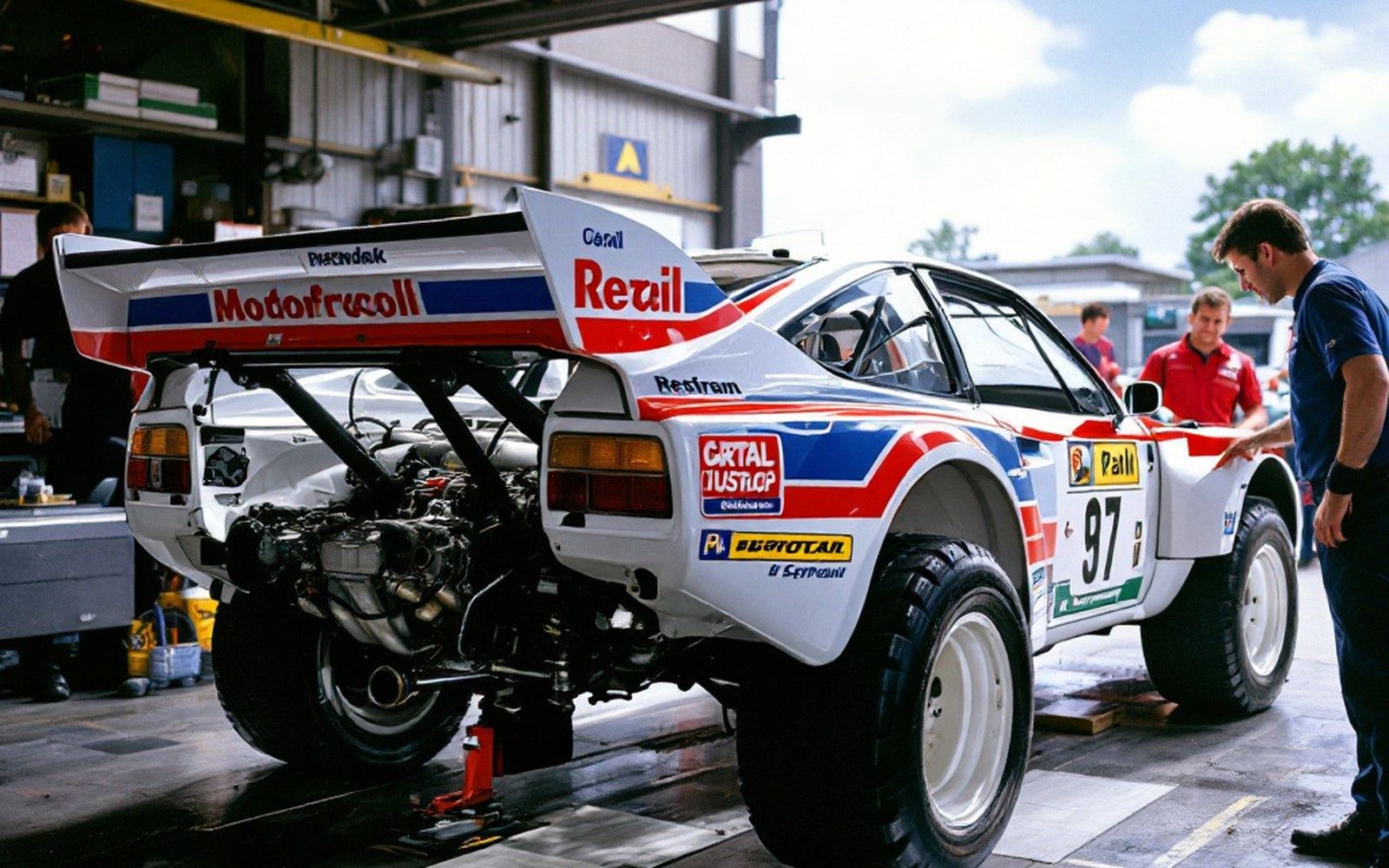
The 1986 Tour de Corse is where the season changed. Toivonen and co-driver Sergio Cresto died when their S4 left the road on the Corte–Taverna stage in May. The cause of the accident was never definitively established. The FIA moved swiftly: Group B was abolished at the end of the 1986 season, the class eliminated rather than reformed. The twin-charging S4, which had existed for fewer than eighteen months of competition, never ran a full championship season under the regulations that created it.
The technical legacy of the car is specific and traceable. The dual-compressor architecture — supercharger for transient response, turbocharger for peak output — appeared in subsequent production vehicles precisely because Lancia and Abarth demonstrated it was buildable and controllable. The Volumex supercharger had already appeared in Lancia road cars; pairing it with a turbocharger in a competition application was the step that had not been taken before. The S4 also reinforced the lesson that composite survival structures needed formal specification: the cars of Group B were fast enough that surviving a departure from the road required engineering rather than luck, a conclusion that the survival cell regulations written into subsequent Formula One rules made explicit in a different context.
The FIA's historical database for Group B homologation records the period during which the class operated. What the S4 demonstrated was that a rulebook's silences are as consequential as its sentences — and that the gap between what the rules permit and what they anticipated can be very wide indeed.